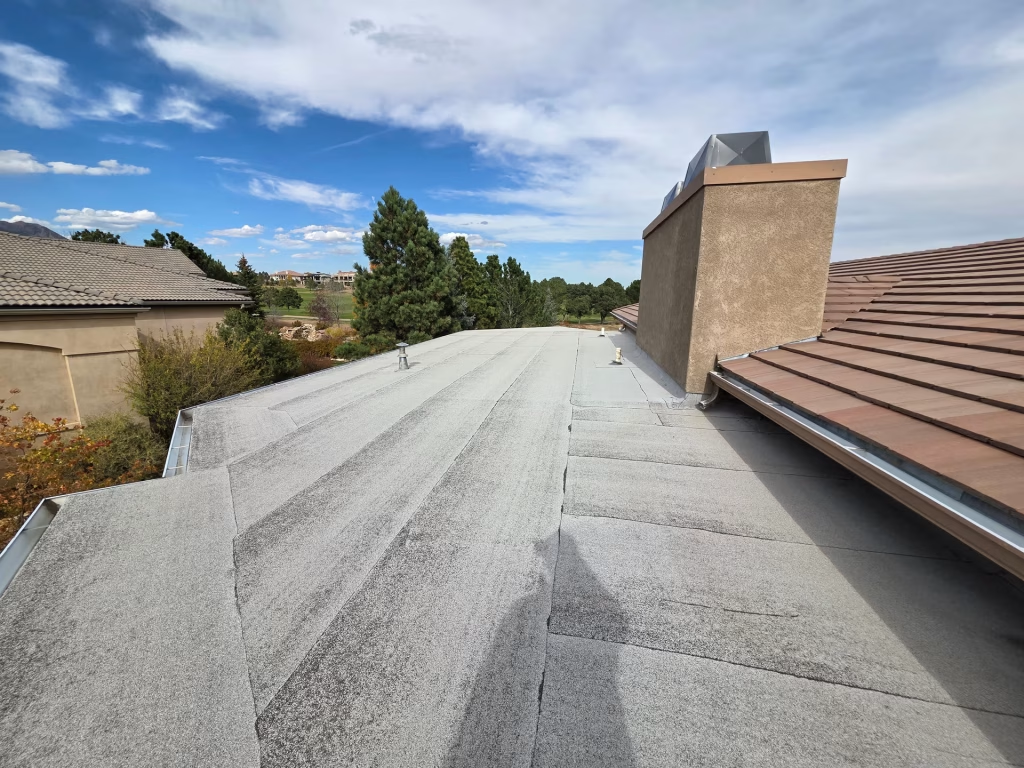
Modified Bitumen in Colorado Springs
Consider a modified-bitumen system for your flat or low-slope roof.
Request an assessment
Share your contact details and property address. We will follow up to discuss what you need and assess the work. No measurements or roofing terminology needed.
Request an assessment
Share your contact details and property address. We will follow up to discuss what you need and assess the work. No measurements or roofing terminology needed.
Google reviews from our customers
Loading Google reviews…Read our customer reviews
Looking for Modified Bitumen in Colorado Springs?
- Are you considering modified bitumen for a low-slope roof?
- Does an existing modified bitumen roof have split seams or damaged areas?
- Want to understand the difference between SBS and APP options?
- Need penetrations, drainage, and roof edges planned with the system?
- Are rooftop access and equipment part of the project?
- Want installation, inspection, and maintenance needs explained?
Your service at a glance
We assess the roof condition and project requirements before recommending installation or repair. Seams, flashings, and drainage are important parts of the scope.
- Existing roof assessment
- Membrane, seams, and flashing
- Repair or replacement options

A local team
Work with High Valley Roofing, LLC in Colorado Springs and El Paso County.
Clear findings
We explain the condition we find and the work proposed for your property.
A defined scope
Review the estimate and scheduling with our team before approving the work.
Assess Modified Bitumen roofing in Colorado Springs
Modified Bitumen is an asphalt-based roofing system used on flat and low-slope roofs. Existing condition, drainage, and installation details guide whether a localized repair or a larger project is practical.
Review the existing roof
We look at the affected surface, seams, edges, flashing, and penetrations. Report leaks or changes you have noticed and any available roof history. You do not need to diagnose the material or damage before booking an assessment.
Repair according to the system
A repair needs compatible materials and suitable surrounding roofing. Damage in several areas or concerns with underlying layers can change the recommendation. We explain what can be addressed locally and what may require broader work.
Plan replacement and ongoing care
If replacement is appropriate, preparation, roof details, drainage, and access belong in the scope. After work, periodic checks help identify changes at seams, transitions, and drains. We discuss the selected system and care needs without promising the same lifespan for every property.
Understand the roof layers
Modified bitumen uses an asphalt-based membrane system, commonly with base and cap layers. Reinforcement, surface finish, flashing, and the underlying roof preparation work together. We identify the existing assembly before proposing repairs or a replacement system.
SBS, APP, and installation methods
SBS- and APP-modified products have different material and application requirements. Depending on the selected system, installation can use self-adhered products, cold adhesive, or heat-applied methods. The estimate should specify the system and suitable installation approach for your roof.
Signs that need a closer look
Open seams, blisters, surface cracks, loose flashing, granule loss, and recurring standing water are reasons for an assessment. A compatible patch or seam repair may be practical when the surrounding material is sound. More extensive moisture or deterioration can call for a broader scope that includes the affected underlying layers.
What SBS and APP mean
SBS is rubber-modified asphalt, while APP is plastic-modified asphalt. These are different product families rather than interchangeable labels. We discuss the selected membrane, its application method, and the requirements for your roof. Base and cap layers, reinforcement, seams, and flashing work together as part of the specified assembly.
Plan access for rooftop maintenance
If maintenance staff need access to equipment on the roof, discuss those routes when planning the project. The existing roof system and selected product requirements guide protection for repeated foot traffic, including designated walk pads where appropriate. Routine inspections still matter at seams, flashing, and drainage points.
How Modified Bitumen works
Clear next steps, from your first question to the agreed work.
Step 1: Assess the existing roof
We inspect the roof surface, moisture concerns, seams, flashing, and drainage before recommending repair or replacement.
Step 2: Specify preparation and materials
We identify the selected modified bitumen system and required preparation, including decking, insulation, and supporting repairs where needed.
Step 3: Complete the agreed roofing work
We install or repair the membrane with compatible materials at seams, flashing, and penetrations and complete the specified drainage work.
Step 4: Inspect and explain maintenance
We review the completed roof, inspection needs, drainage care, and any designated equipment-access routes.
Common questions
Can the existing roof be repaired?
A localized issue may be repairable if the surrounding system is in suitable condition. We inspect it before recommending repair or replacement.
Does standing water mean I need a new roof?
Not necessarily. We assess the drainage, affected materials, and roof condition to establish what work is needed.
What problems should I watch for on a modified bitumen roof?
Report recurring leaks, visible damage, changes around seams or penetrations, and drainage concerns. The findings need assessment before deciding whether repair or replacement is appropriate.
How long will a modified bitumen roof last?
Condition, installation, exposure, maintenance, and the selected system influence service life. We assess the actual roof and explain its condition rather than promise a fixed lifespan.
Related services in Colorado Springs
Explore related services from High Valley Roofing, LLC, or browse all 47 services.
- Flat Roofing — Get help with leaks, damage, or replacement on a flat or low-slope roof.
- TPO & EPDM Roofing — Compare TPO and EPDM systems for your flat or low-slope roof.
- Commercial Flat Roofing — Plan flat-roof work around your commercial building and its daily use.
- Flat Roof Repair — Have a flat-roof leak or damaged area assessed for a compatible repair.
- Roof Coatings — Find out whether your existing roof is a suitable candidate for a coating.
Request Modified Bitumen in Colorado Springs
Contact High Valley Roofing, LLC to discuss your property and the next step. We serve Colorado Springs and El Paso County.
Call 719-373-9985. Monday–Saturday, 7:30 AM–5 PM; Sunday closed.