
Hail Damage Roof Repair in Colorado Springs
Find out whether a hailstorm damaged your roof and what needs attention.
Request an assessment
Share your contact details and property address. We will follow up to discuss what you need and assess the work. No measurements or roofing terminology needed.
Request an assessment
Share your contact details and property address. We will follow up to discuss what you need and assess the work. No measurements or roofing terminology needed.
Google reviews from our customers
Loading Google reviews…Read our customer reviews
Looking for Hail Damage Roof Repair in Colorado Springs?
- Has hail recently passed through your neighborhood?
- Have you noticed shingle granules or bruised-looking areas?
- Are gutters, vents, or other roof details dented?
- Has a new leak appeared since the hailstorm?
- Want the roof checked even though it is not leaking?
- Need photos and findings for a repair or insurance discussion?
Your service at a glance
We inspect roofing and exposed details, document the findings, and explain repair options. If you pursue a claim, coverage remains your insurer's decision.
- Shingles and other roof materials
- Flashing, vents, and gutters
- Photos and a proposed repair scope

A local team
Work with High Valley Roofing, LLC in Colorado Springs and El Paso County.
Clear findings
We explain the condition we find and the work proposed for your property.
A defined scope
Review the estimate and scheduling with our team before approving the work.
Assess roof concerns after Colorado Springs hail
Hail Damage Roof Repair starts with an inspection of the affected roof and related components. Damage may involve more than the visible shingles, and the extent of the findings guides the repair recommendation.
Tell us what changed after the storm
Report new staining, leaks, visible material damage, or changes to gutters and vents. Photos taken safely from the ground can help explain your concern. We assess the roof rather than asking you to determine the severity yourself.
Review the roof and its details
Shingles, flashing, vents, and other roof components can be affected differently. We document the findings and explain whether a targeted repair is practical or broader work should be considered. A storm report alone does not establish the required scope.
Plan the next steps
We provide an estimate for the work identified and can supply documentation for an insurance discussion. If temporary protection is needed, we do our best to arrange help during business hours when weather and availability allow. Permanent repairs remain a separate scope.
What hail damage can look like
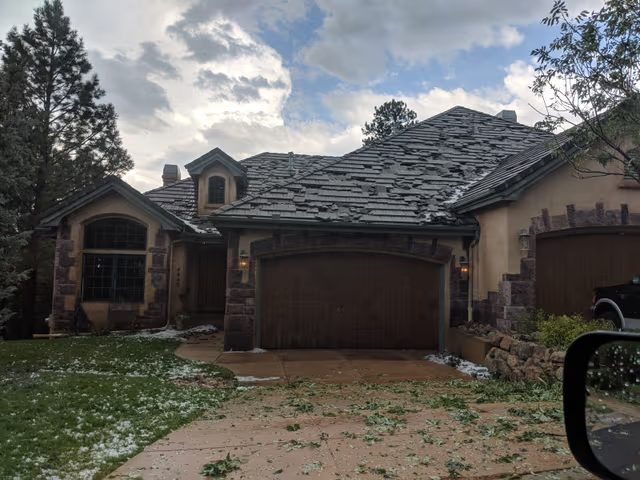
An inspection may find bruised shingles, missing granules, cracked tiles, or impact damage to vents, flashing, and gutters. The absence of a leak does not establish that the roof is undamaged. Equally, a dent or storm in the neighborhood does not by itself establish that a complete replacement is needed.
Keep the roof and drainage scope connected
Hail can affect roof coverings and the metal components around them differently. We explain which areas need repair and whether gutter or flashing work belongs in the proposal. Inspection photos help you understand those recommendations and retain a record for any insurance discussion.
How to spot hail damage from the ground
You don't need to climb onto the roof to notice that something changed after a storm. Climbing a roof after hail is risky, so we'd rather you stay on the ground and let us do the close inspection. From the ground or a window, these are common signs worth reporting to us:
- Granules collecting at downspouts or in gutters. Asphalt shingles are covered in mineral granules. A noticeable pile at the bottom of a downspout after a storm can mean impacts knocked them loose.
- Dents in soft metal. Gutters, downspouts, roof vents, and flashing often show hail dents more clearly than the shingles do. Dents on these parts tell us the roof is worth checking.
- Dark or bruised-looking spots on shingles. Impacts can expose the darker layer beneath the granules.
- Cracked, chipped, or displaced pieces, especially on tile roofs or older shingles.
- Damage around the house. Dented window wraps, damaged siding, or broken screens on the same side of the home suggest the roof took impacts too.
- New stains or drips inside. A leak after a storm is a reason to call promptly, but a dry ceiling does not mean the roof escaped damage.
Hail damage is not always visible right away, and some of it only shows up as the roof ages. That is why we inspect and document what we find instead of relying on a storm report alone.
What to do after a hailstorm
- Stay safe first. Stay off the roof and keep clear of downed lines or hanging debris.
- Take photos from the ground. Photograph dents in gutters and vents, granules at downspouts, damaged siding or windows, and any interior stains. Note the storm date.
- Limit further water entry if you can do it safely. Move belongings away from an active leak and catch the water. If the roof needs temporary protection, contact us. We do our best to arrange help during business hours when weather and crew availability allow.
- Schedule a roof inspection. We inspect the roof and its details, document the findings with photos, and explain what we found.
- Review your policy. Check your homeowners policy for your deductible and any time limits for reporting damage, and contact your insurer with questions about coverage.
- Take your time before signing. After big storms, many contractors canvass neighborhoods. Under Colorado law, a roofing contract must be in writing and include specific terms. Read it before you sign (see the insurance section below).
The insurance claim process, step by step
Insurance decisions belong to your insurer, and every policy is different. We can't predict or promise what a claim will cover. What we can do is explain the usual steps and the role we play:
- Inspection and documentation. We inspect the roof and provide our findings, photos, and a roofing estimate for the work we identify.
- You file the claim. The policyholder files the claim with the insurer. Ask your insurer about deadlines and what they need from you.
- Adjuster inspection. The insurer usually sends an adjuster to look at the roof. We always recommend that your contractor of choice be at this appointment. It's important to have someone in your corner who knows the roofing industry, and we're glad to attend when you ask.
- The insurer's decision. The insurer decides coverage and approves, partially approves, or denies the claim under your policy.
- Scope and contract. If you go ahead, we confirm the scope of work with you in a written contract before the work starts.
Colorado homeowner protections worth knowing (C.R.S. 6-22-101 to 105): - A roofing contractor must give you a written contract, signed by both parties, before any roofing work begins. It must state the scope, approximate dates, approximate costs, and the contractor's contact details (C.R.S. 6-22-103). - The contract must include a clause that lets you rescind within 72 hours of signing and get a full deposit refund (C.R.S. 6-22-103(1)(f)). - If the work will be paid with insurance proceeds and your insurer denies the claim in whole or in part, you can rescind within 72 hours of receiving the insurer's written notice of denial (C.R.S. 6-22-104). - A contractor may not pay, waive, or rebate your insurance deductible, or promise to (C.R.S. 6-22-105). Your deductible is yours to pay.
Our related services, Insurance Claim Assistance and Insurance Restoration, cover the documentation and restoration side in more detail.
Permits and inspections in Colorado Springs and El Paso County
Building permits in Colorado Springs and most of El Paso County are handled by the Pikes Peak Regional Building Department (PPRBD). According to PPRBD's guidance for homeowners:
- Replacing a roof because of hail damage requires a reroof permit.
- Repairs of 100 square feet or less do not need a permit (Pikes Peak Regional Building Code, RBC105.2, item 14).
- When a contractor does the work, the contractor pulls the permit. A homeowner can pull their own permit only for a home they own and live in, and only when doing the work themselves.
- Reroofing requires a license. PPRBD's reroof guidelines say it is a code violation for anyone to contract or perform reroofs of more than 100 sq ft without a license, unless they own the residence. You can check a contractor's license with PPRBD.
- Permitted reroofs are inspected under PPRBD's requirements.
- Damaged siding or windows may need separate permits.
High Valley Roofing, LLC holds an active roofing license with the Pikes Peak Regional Building Department, license #23230, and pulls the required permits for the reroofing work we perform.
Sources: PPRBD, "Questions for homeowners" on roofing (https://www.pprbd.org/Notices/Roofing_homeowners.pdf); PPRBD Reroof Guidelines (https://www.pprbd.org/File/ByAlias/ReroofGuidelines); Pikes Peak Regional Building Code 2023, RBC105 (https://www.pprbd.org/File/ByAlias/PPRBC2023Edition2ndPrinting).
Impact-resistant shingles
When a hail-damaged roof needs replacing, some homeowners ask about impact-resistant shingles. These are shingles tested to resist impact, often rated Class 4 under the UL 2218 standard. A rating describes performance in a standardized test. It does not mean a shingle can't be damaged by hail. Some insurers offer premium discounts for impact-resistant roofs. Ask your insurer whether that applies to your policy.
High Valley Roofing installs impact-resistant shingles from Atlas, GAF, Owens Corning, Malarkey, and CertainTeed, and we offer other brands as well. We can explain the options and how they compare, so you can decide what fits your home and budget.
Hail history in Colorado Springs and El Paso County
The Colorado Springs area sees serious hail. Here are three recent storms from NOAA's public storm reports:
- August 6, 2018: hail up to 4 inches was reported 2 miles east-southeast of Security, and 2.75-inch hail was reported south of Colorado Springs.
- August 5, 2023: hail of 3 to 4 inches was reported about 13 miles south-southeast of Schriever Space Force Base. Baseball-size hail (3 inches and up) was reported north of Pinon.
- June 23, 2026: 22 hail reports across El Paso County that evening and overnight, including 1.75-inch hail in Colorado Springs and 2.5-inch hail in and east of Fountain.
A storm in your area is not proof your roof was damaged, and a lack of reports is not proof it wasn't. The only way to know is an inspection.
Source: NOAA Storm Prediction Center, daily storm reports (https://www.spc.noaa.gov/climo/reports/180806_rpts.html, https://www.spc.noaa.gov/climo/reports/230805_rpts.html, https://www.spc.noaa.gov/climo/reports/260623_rpts.html). Long-term records: NOAA NCEI Storm Events Database (https://www.ncdc.noaa.gov/stormevents/).
Areas we serve for hail damage roof repair
High Valley Roofing, LLC provides hail damage roof repair across Colorado Springs and El Paso County, including Monument, Fountain, Falcon, Peyton, Black Forest, and Security. If you're not sure whether your address is in our area, call 719-373-9985.
More hail damage questions
Do I need a permit to repair or replace a hail-damaged roof in Colorado Springs?
The Pikes Peak Regional Building Department requires a reroof permit for roof replacement. Repairs of 100 square feet or less don't need one. When a contractor does the work, the contractor pulls the permit.
Can a roofing contractor cover my insurance deductible?
No. Colorado law (C.R.S. 6-22-105) prohibits roofing contractors from paying, waiving, or rebating a homeowner's insurance deductible, or promising to do so.
My roof isn't leaking. Should I still have it checked after hail?
Yes, it's worth checking. Hail can bruise shingles and dent metal parts without causing a leak right away. An inspection documents the roof's condition so you can decide on the next step.
How Hail Damage Roof Repair works
Clear next steps, from your first question to the agreed work.
Step 1: Contact our team
Tell us your property address and what you need help with. You do not need to identify the cause yourself.
Step 2: Review the assessment
We assess the roofing materials, flashing, ventilation, and the relevant roof details and explain the findings, proposed work, and estimate.
Step 3: Agree on the next step
Once you approve the scope, we coordinate the agreed work. Timing depends on the project, weather, and availability.
Step 4: Review the outcome
We explain the completed work or inspection findings and answer questions about recommended follow-up care.
Common questions
Can you document damage for a claim?
We can provide inspection findings, photos, and a roofing estimate. Your insurer decides coverage and claim approval.
Is urgent temporary protection available?
We do our best to arrange temporary protection during business hours when weather and crew availability allow. Same-day response is not guaranteed.
Will insurance cover a new roof after hail?
Your insurer decides coverage and claim approval under your policy. We can provide roofing findings, photos, and an estimate, but cannot guarantee a replacement will be covered.
How much does hail-damage roof repair cost?
The affected materials, extent of damage, access, and necessary repair details determine the estimate. We inspect before recommending and pricing the work.
Related services in Colorado Springs
Explore related services from High Valley Roofing, LLC, or browse all 47 services.
- Roof damage repair — Have visible roof damage assessed before it leads to further water entry.
- Storm / Wind Damage Roof Repair — Have missing shingles or other wind damage assessed after a storm.
- Insurance Claim Assistance — Get roof-damage documentation and a clear estimate to support your insurance claim.
- Insurance Restoration — Restore damaged roofing and gutters with a scope based on the property assessment.
- Emergency Tarping Services — Request temporary roof protection after damage or an active leak.
- Roof Repair Tile Roofing
Request Hail Damage Roof Repair in Colorado Springs
Contact High Valley Roofing, LLC to discuss your property and the next step. We serve Colorado Springs and El Paso County.
Call 719-373-9985. Monday–Saturday, 7:30 AM–5 PM; Sunday closed.